Are silicone baking mats toxic? Under normal baking use, quality silicone baking mats made for food contact are generally not treated as inherently toxic products. The bigger risk is not the word silicone by itself. The bigger risk is low-quality material, unknown fillers, poor curing, overheating misuse, or continuing to use a mat that is already breaking down.
That distinction matters because many readers are not really asking one question. They are asking several at once: Do silicone mats release harmful substances? Do they contain BPA or PFAS? Is odor after heating normal? Can overheating make them unsafe? And how do you tell a trustworthy mat from a cheap one?
This guide focuses on those toxicity concerns directly, so it complements broader safety guidance instead of repeating it word for word.
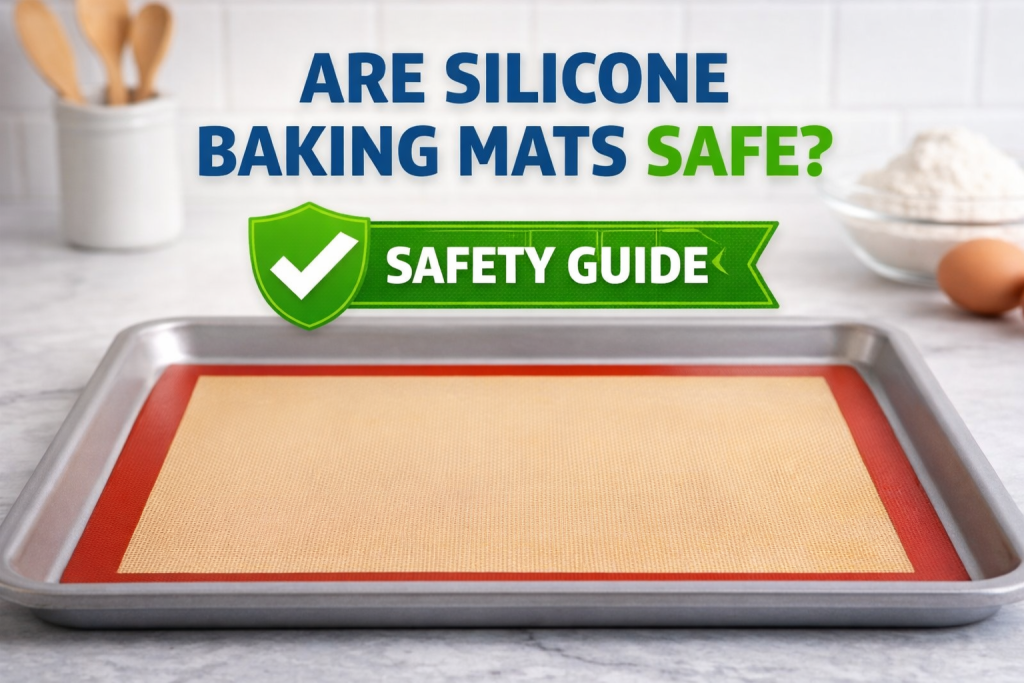
Table of Contents
- Direct answer
- Why people worry about toxicity
- Do silicone baking mats contain BPA or PFAS?
- Food-grade silicone vs low-quality material
- What odor, smoke, and stickiness may actually indicate
- Can overheating make a silicone mat unsafe?
- What home cooks should check
- What buyers and importers should check
- When to replace, not just clean
- FAQ
Direct answer
For normal household baking, a well-made silicone baking mat used within its rated temperature range is generally treated as a low-risk food-contact product. That does not mean every silicone mat on the market is equally trustworthy. It means the real question is whether the product is made from suitable material, cured properly, used correctly, and replaced when worn out.
If you want the broader version of this topic, start with this companion article on whether silicone baking mats are safe. This article goes narrower and focuses on the chemical-risk concerns behind the word toxic.
Why people worry about toxicity
People usually search this topic because they have seen one of these warning signs:
- a strong smell after heating
- smoke from a mat used too hot or too close to direct heat
- a sticky or powdery surface after repeated use
- confusion about BPA, PFAS, plastics, and food-contact chemicals
- uncertainty about whether a cheap mat is made to the same standard as a trusted brand
Those concerns are understandable. But they should be separated instead of mixed together. A food-contact material question is different from a misuse question. An odor problem is different from a BPA question. A worn-out mat is different from a new compliant one.
Do silicone baking mats contain BPA or PFAS?
These are two of the most common fear terms in this topic cluster, but they are not catch-all labels for every kitchen material.
BPA is a specific chemical associated with some other food-contact material systems. It is not a general synonym for all bakeware or all flexible kitchen materials.
PFAS is a separate category that has received heavy regulatory attention in certain food-contact uses, especially grease-resistant paper applications. Again, it is not a shortcut way to describe every silicone product.
That means the better question is not “Does this mat sound scary?” The better question is “What is this product made from, how is it manufactured, and what documentation supports its intended use?”
If your concern starts at the material level, it helps to understand how food-grade silicone manufacturing is controlled before the product ever reaches the oven.
Food-grade silicone vs low-quality material
The toxicity conversation gets distorted when all silicone mats are treated as if they come from the same material system. They do not.
A higher-quality baking mat should be designed for repeated food contact, stable under its rated temperature range, and supported by consistent manufacturing control. A low-quality or poorly controlled product may raise more concern because:
- the material source is unclear
- the curing process may be inconsistent
- the supplier cannot explain compliance clearly
- odor and surface performance may vary more from batch to batch
- printed decorations or pigments may become the weak point even if the base silicone is acceptable
So if a buyer asks whether silicone baking mats are toxic, the practical answer is often: trustworthy products and questionable products should not be judged the same way.
What odor, smoke, and stickiness may actually indicate
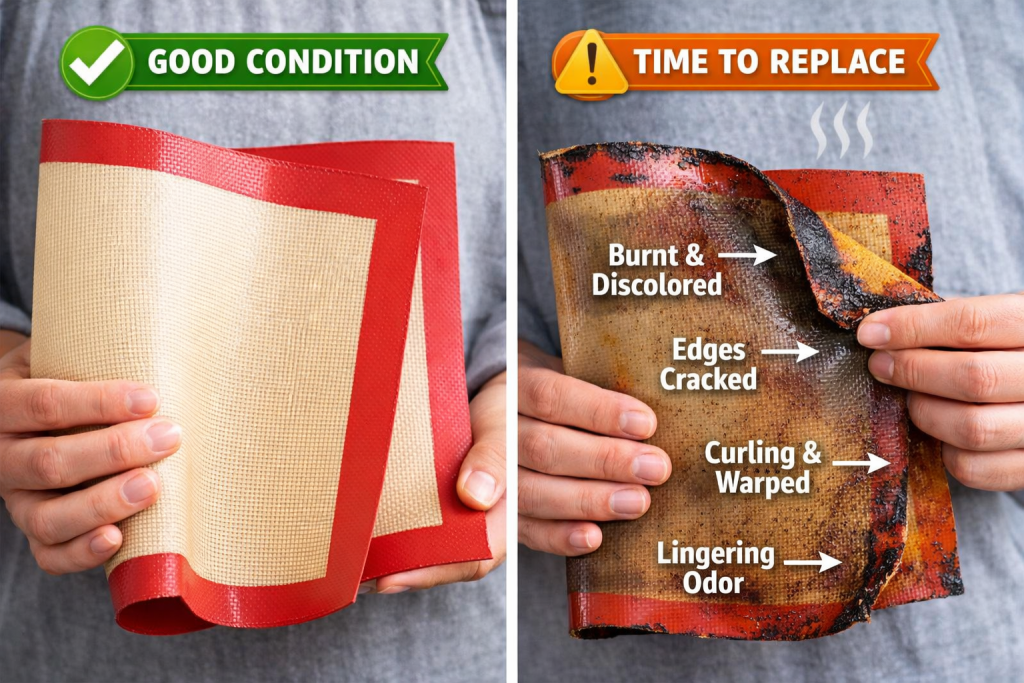
A strong chemical smell does not automatically prove a product is toxic, but it is also not something to wave away casually.
These signs deserve attention:
- strong persistent odor: may suggest residue buildup, aging, poor curing, or poor product quality
- unexpected smoke: often points to overheating or direct heat misuse, not normal baking use
- sticky surface changes: can indicate residue, wear, or material breakdown
- visible delamination or exposed mesh: means the mat is no longer in acceptable condition for continued use
In short, users should not panic over every smell, but they also should not keep using a mat that clearly behaves abnormally after normal washing and proper baking use.
Can overheating make a silicone mat unsafe?
Yes, misuse matters.
Silicone baking mats are made for baking, not for direct flame, grills, exposed heating elements, or broiler-level abuse. A mat can be acceptable under normal baking conditions and still become a poor choice under temperatures or setups it was never designed to handle.
That is why “Is it safe to bake with silicone?” and “Is silicone toxic?” are related but not identical questions. A mat used correctly and a mat overheated under direct radiant heat should not be judged as the same situation.
- Follow the rated temperature for the exact product.
- Do not use silicone mats on open flame or grills.
- Do not place them directly against exposed heating elements.
- Stop using a mat if abnormal odor, smoke, or surface changes appear under normal conditions.
What home cooks should check
If you are buying for personal use, the most useful checklist is simple:
- buy from a brand or supplier that explains the product clearly
- follow the temperature guidance for that exact mat
- avoid cutting, folding, scorching, or scraping the surface
- wash gently and replace the mat when it shows breakdown
- take persistent odor, smoke, or unusual stickiness seriously
Readers who are mainly asking about general everyday use should still be routed to broader silicone baking mat safety guidance, because toxicity concerns often overlap with heat, care, and product-age questions.
What buyers and importers should check
For importers and private-label buyers, this topic is less about fear wording and more about supplier proof.
Ask for:
- food-contact compliance documentation for the target market
- material declarations tied to the actual product configuration
- clarity on curing consistency and batch control
- temperature rating for the exact item, not a generic line-sheet claim
- test reports or third-party support where appropriate
- review of pigments, printing, and decoration methods if the product is branded
If a supplier cannot answer those questions cleanly, the problem is not just SEO wording. It is a trust problem. A credible custom silicone mat manufacturer should be able to explain both product performance and material-control logic in plain language.
“Non-toxic” is not a useful buying standard by itself. What matters is the material system, the curing quality, the intended use, the temperature limit, and the supplier’s ability to prove consistency.
When to replace, not just clean
Some problems should not be treated like cleaning problems forever. Replace the mat if you see:
- persistent strong odor after repeated normal washing
- surface stickiness that does not improve after cleaning
- tears, cracks, edge fraying, or exposed mesh
- visible delamination
- warping or surface breakdown after repeated use
Once a mat is physically breaking down, continuing to debate whether it is “toxic” misses the point. It is no longer a good product to keep in service.
FAQ
Are silicone baking mats toxic?
Under normal baking use, quality silicone baking mats intended for food contact are generally not treated as inherently toxic. The bigger concerns are low-quality material, poor curing, overheating misuse, and worn-out mats that should be replaced.
Are silicone mats safe for baking?
Usually yes, if they are made for food contact and used within the rated temperature range. Safety depends on product quality, intended use, and condition.
Are silicone baking sheets safe too?
Usually yes. In most cases, “silicone baking sheet” and “silicone baking mat” describe the same general product type, so the same safety checks apply.
Do silicone baking mats contain BPA?
BPA is a specific chemical associated with some other material systems. It should not be used as a catch-all label for every kitchen product. The better question is whether the specific mat is made and documented appropriately for food-contact use.
Do silicone baking mats contain PFAS?
PFAS concerns are heavily discussed in some food-contact applications, especially grease-resistant paper. Silicone mats should be evaluated as their own product category, based on material system, intended use, and supplier documentation.
Why does my silicone mat smell after heating?
A smell can come from residue, product aging, poor curing, or overheating misuse. A strong persistent odor after proper washing deserves attention and may be a sign the mat should be replaced.
Can overheating make a silicone mat unsafe?
Yes. Silicone mats are not made for open flame, grills, broilers, or direct contact with exposed heating elements. Normal baking use and overheating misuse are not the same thing.