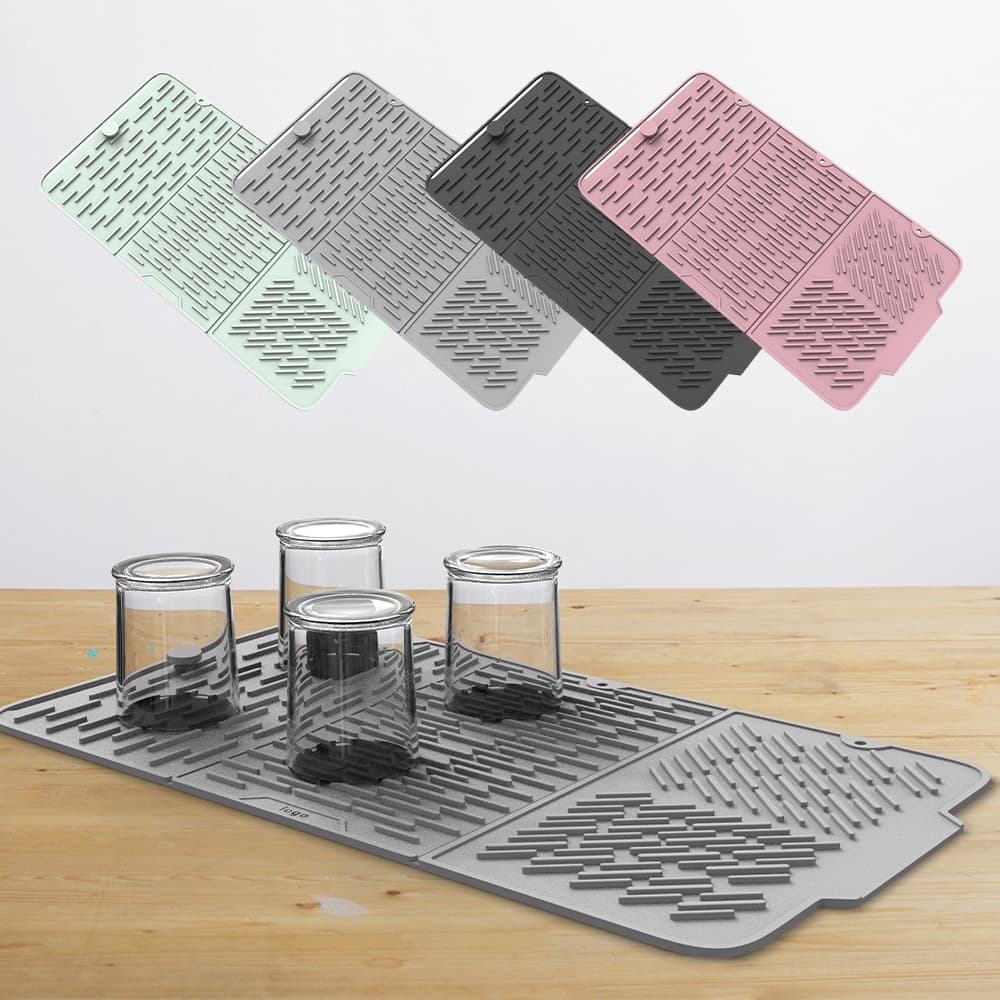
Short answer: Most custom silicone mat projects slow down because buyers ask about price first and process second. In reality, MOQ, tooling, sample revisions, and lead time are what decide whether the project stays smooth after the first quotation.
These details look boring on day one, but they control cost, launch timing, and how many avoidable surprises appear between sample approval and mass production.
If you are already comparing one OEM silicone mat supplier against another, this is the checklist that helps you understand which quote is actually realistic.
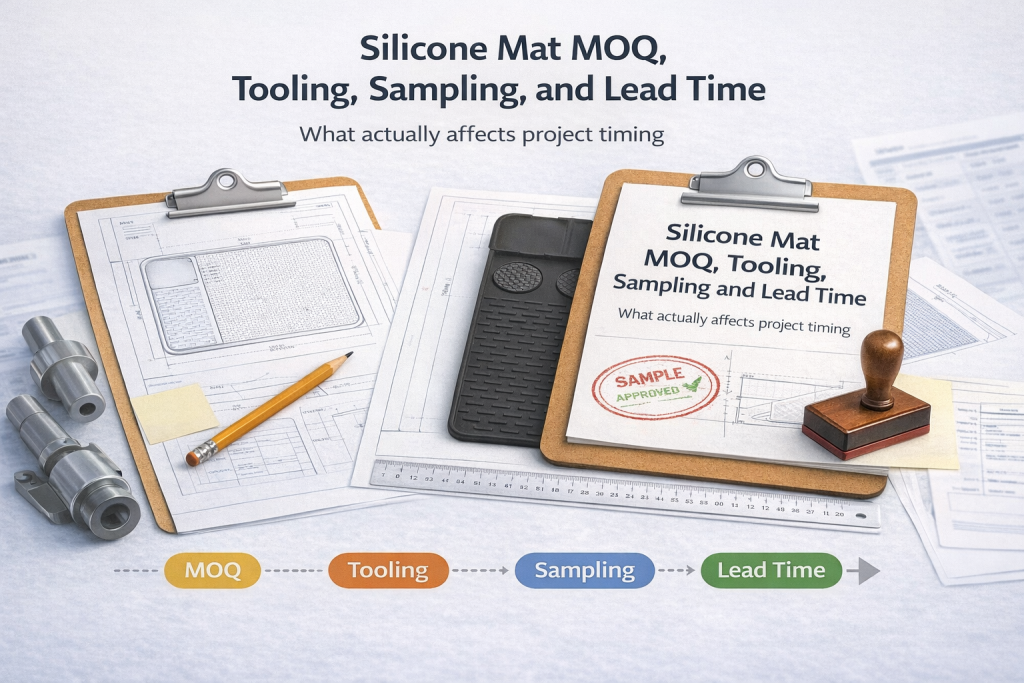
Table of Contents
- Why MOQ, tooling, and lead time need to be discussed together
- What affects MOQ on custom silicone mat projects
- When tooling is required
- What sample rounds usually look like
- What drives lead time up or down
- Questions to clarify before paying deposit
- FAQ
Why MOQ, tooling, and lead time need to be discussed together
Buyers often ask these as separate questions, but they are linked.
- a more customized design may increase tooling needs
- tooling complexity can affect sample time
- sample changes can affect the final lead time
- MOQ can shift depending on packaging, color, logo, and process route
That is why a quotation without process context is only half a quotation.
What affects MOQ on custom silicone mat projects
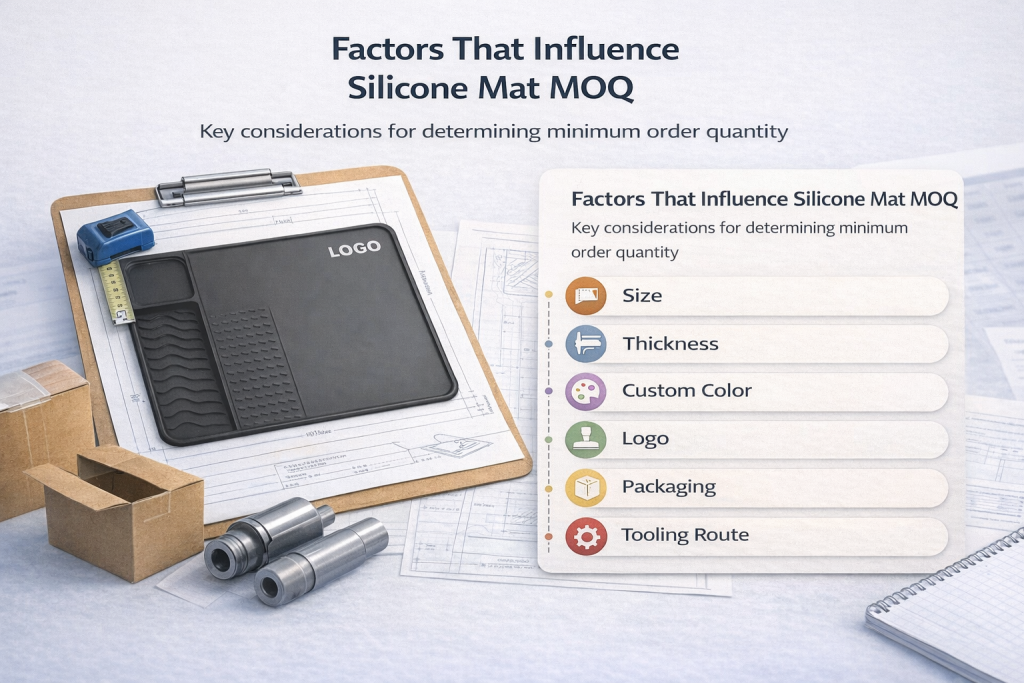
MOQ is rarely just one magic number. It often changes based on:
- size and thickness
- custom color requirements
- logo or printed pattern method
- retail packaging needs
- whether the design uses a new tool or an adjusted existing route
Some buyers hear a low MOQ and assume the whole project is now flexible. That can be misleading if the supplier has not explained what version of the project that MOQ actually applies to.
In real projects, MOQ usually shifts with the exact customization package. A mat with standard dimensions and simple bulk packing may support one MOQ logic, while the same mat with a custom color, debossed logo, retail box, barcode labeling, or special texture may follow a different minimum entirely.
| Project variable | Why it changes MOQ logic |
|---|---|
| Size and thickness | Changes material usage and sometimes production route |
| Logo method | May add process steps or affect tooling detail |
| Texture or surface pattern | Can increase tooling or setup complexity |
| Color matching | May require stricter batching or minimum run control |
| Retail packaging | Often creates separate MOQ logic outside the mat alone |
If you are still choosing suppliers, start with how to source a custom silicone mat manufacturer first. It helps you judge whether the quote logic is trustworthy before you compare MOQ numbers line by line.
When tooling is required
Tooling is usually required when the project involves a new shape, a specific structure, or custom surface details that cannot be achieved through an existing route.
- new dimensions may be simple or may require a new tool depending on structure
- texture, raised zones, drainage layout, and special edges can affect tooling complexity
- logo integration can also change the tooling plan
Buyers often underestimate how quickly “small” design decisions become tooling decisions. Rounded corners, anti-slip zones, measurement markings, divided sections, drainage channels, and embossed brand areas can all move a project from a simple adjustment into a more custom mold route.
That is also why material and compliance conversations should happen early. If the mat needs food-contact positioning, discussing that with an FDA silicone supplier early helps avoid changing direction after tooling decisions are already underway.
What sample rounds usually look like
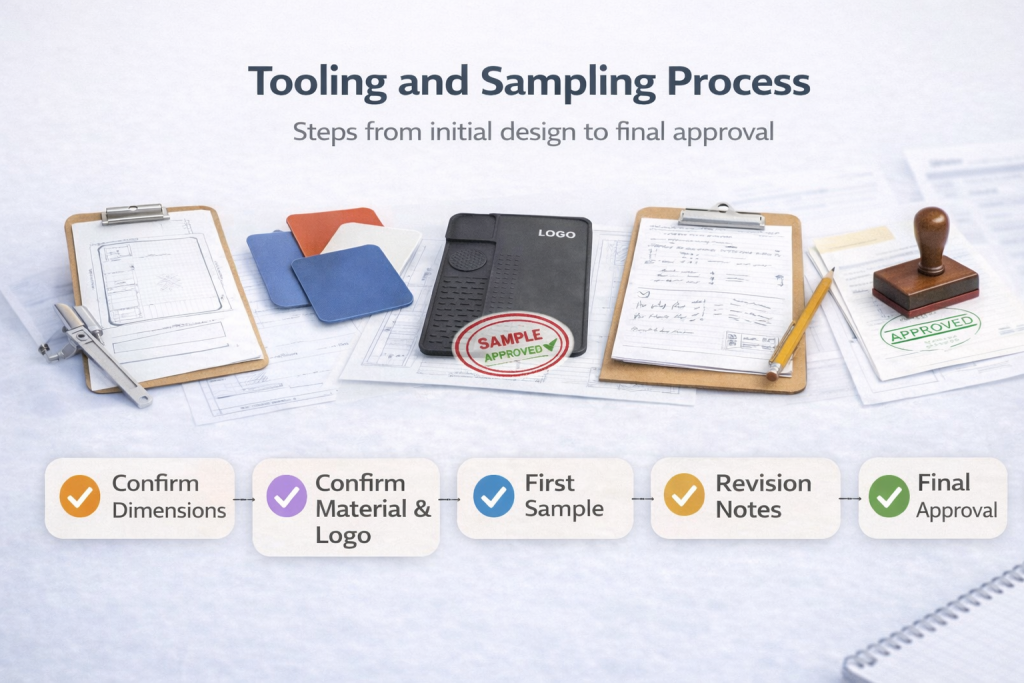
A smooth sample process usually looks something like this:
- confirm dimensions, use case, and key features
- confirm material, color, logo, and packaging direction
- receive first sample or sample photos
- review changes clearly and in writing
- approve final direction before mass production
Projects usually get delayed when revision rules are not defined. Buyers should know what counts as a normal adjustment and what creates a bigger reset in time or tooling cost.
In practice, a good sample route feels like a controlled handoff, not a string of vague updates. The best suppliers usually confirm drawing details first, then move into sample execution with visible checkpoints for logo placement, surface texture, packaging direction, and any functional details such as drainage, raised zones, or measurement markings.
A useful way to think about it is as a five-step custom project flow:
- confirm drawing and intended use
- confirm material, surface, and branding details
- make or adjust tooling if needed
- review sample and lock revisions
- move to production only after final approval
What drives lead time up or down
Lead time is not just a factory-speed issue. It moves with project clarity.
- unclear drawings slow everything down
- frequent revisions add time quickly
- special packaging can extend the schedule
- compliance-sensitive markets may require more coordination
- peak production periods can stretch realistic delivery windows
Lead time also rises when buyers finalize the product in the wrong order. If dimensions, surface details, logo method, and packaging are still open after the first quote, the published schedule is usually only a rough placeholder. The more the project behaves like a moving target, the less useful the original timeline becomes.
If performance conditions are still being finalized, our guide on silicone mat temperature limits can help prevent late-stage design changes caused by overlooked use conditions.
Questions to clarify before paying deposit
Before paying deposit, buyers should be able to answer these clearly:
- What MOQ applies to the exact version we are ordering?
- Is tooling included, partial, or separate?
- How many sample rounds are expected?
- What change requests could affect timing or cost?
- What production lead time applies after final sample approval?
- What packaging work is included?
A useful rule is this: if the supplier cannot explain the relationship between customization scope, sample route, and production timing in one clean reply, the quote probably is not mature enough for deposit yet.
If you are sourcing silicone mats for resale or private label, a reliable custom silicone mat manufacturer should be able to explain those timing and tooling dependencies without hiding them behind a one-line quote.
If your project also needs careful material positioning, pair this article with the food grade silicone mat guide so MOQ and lead time decisions are not made separately from compliance expectations.
MOQ, tooling, sampling, and lead time are not admin details. They are the real structure of a custom silicone mat project.
FAQ
What affects MOQ for custom silicone mats?
Size, thickness, color, logo method, packaging, and whether the project needs a new tooling route can all affect MOQ.
Do all silicone mat projects need new tooling?
No. Some projects can use an existing route with adjustments, while others need new tooling because of shape, surface detail, or structure.
How many sample rounds are normal?
That depends on project complexity, but buyers should clarify revision logic early so sample changes do not create avoidable delays.
Why does lead time change after the first quote?
Because design changes, packaging, sample revisions, compliance coordination, and production scheduling all affect the real timeline.
What should I confirm before paying deposit?
Confirm the exact MOQ, tooling scope, sample expectations, lead time after approval, packaging scope, and what changes can affect timing or cost.