Short answer: A silicone baking mat’s safe heat limit is not one universal number. Many consumer baking mats are rated around 428 F, while some bread-specific mats go higher, but the only number that matters is the rating for the exact product you are using.
The confusion starts when people treat the phrase heat resistant like it means unlimited heat tolerance. It does not. Oven setting, tray placement, contact with oven walls, broiler use, and direct exposure to heating elements all change the risk picture.
That is why brands comparing specs across a silicone mat factory should ask for the operating range of the exact mat, not copy a generic catalog claim from a different product.
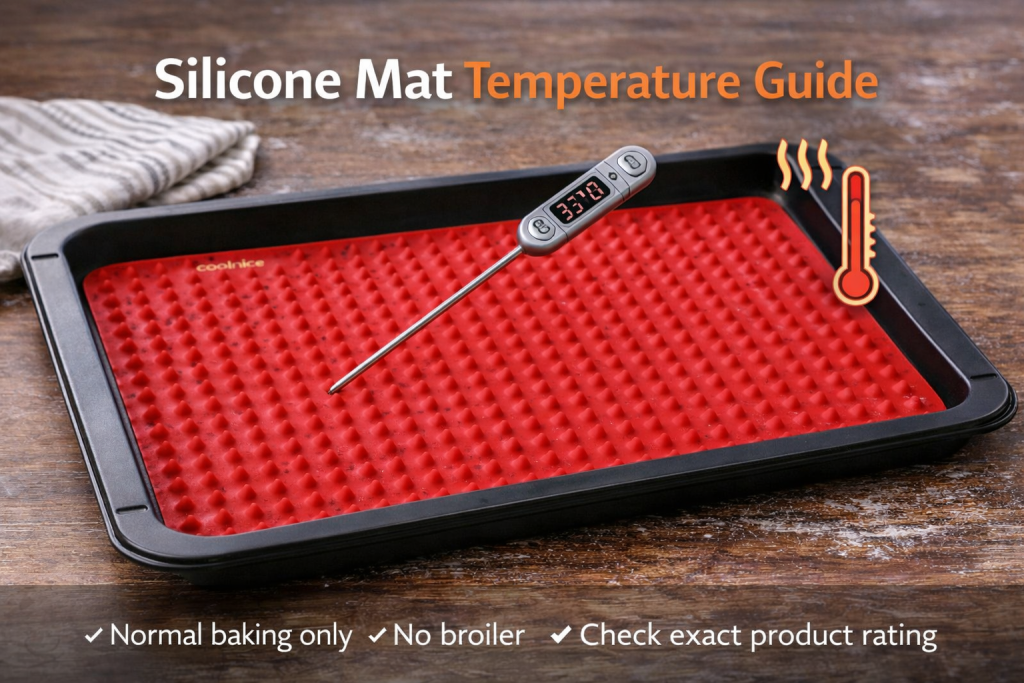
Table of Contents
- Quick answer
- What temperature range is common?
- Why oven temperature is not the whole story
- Does heat resistant mean broiler safe?
- What overheating can look like
- How temperature affects safety and product life
- What buyers should ask suppliers
- FAQ
Quick answer
If the mat is used within its rated temperature range, kept away from direct flame and broilers, and not pressed against exposed heating elements or oven walls, it is usually suitable for normal baking use. The mistake is assuming all mats share the same limit.
What temperature range is common?
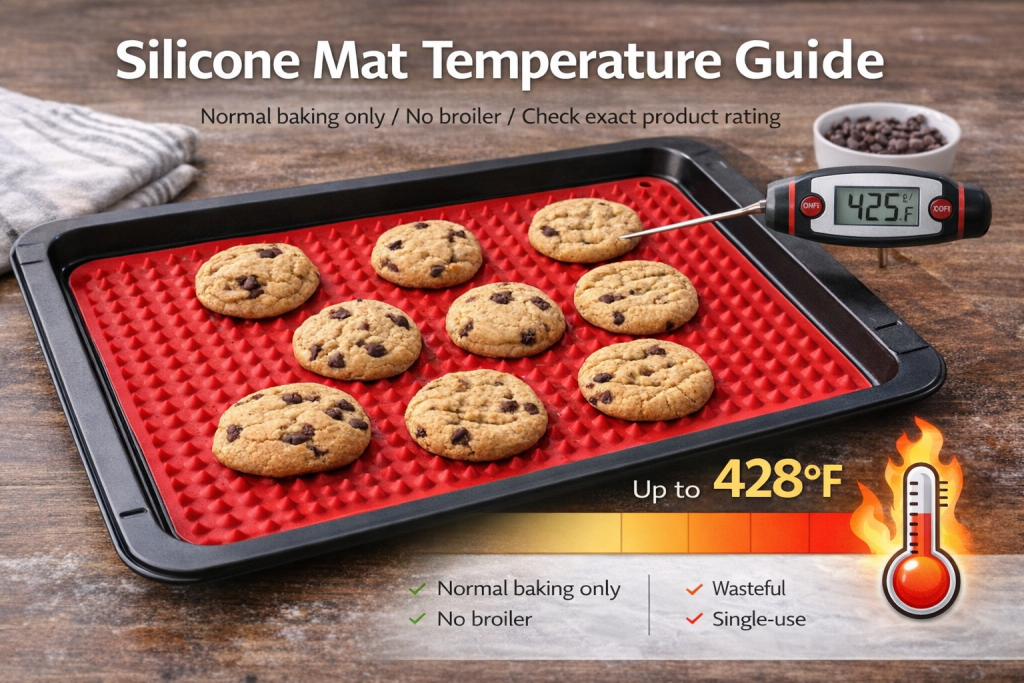
Many silicone baking mats sold for regular home baking are rated around 428 F. Maison Demarle’s guidance, for example, says its baking mats are oven-safe up to 428 F, while some bread baking mats are rated up to 464 F. That tells you something important: even within one brand family, the limit changes by product design.
So when someone asks for the silicone baking mat max temperature, the useful answer is not a single internet number. The useful answer is: check the exact mat, because thickness, reinforcement, intended use, and construction all affect the rating.
- standard baking mats may have one oven limit
- bread mats may have a different oven limit
- custom mats for industrial or specialty use may have their own performance window
Why oven temperature is not the whole story
A 400 F oven setting does not mean every part of the oven behaves like a steady 400 F environment. Local hot spots matter.
- broilers create much more aggressive top heat
- edges near oven walls may run hotter
- contact with exposed heating elements is a misuse condition
- dark trays and certain rack positions can intensify heat exposure
If you want the practical setup habits that reduce these mistakes, read our guide on how to use a silicone baking mat correctly. Correct tray placement matters as much as the rated number on paper.
Does heat resistant mean broiler safe?
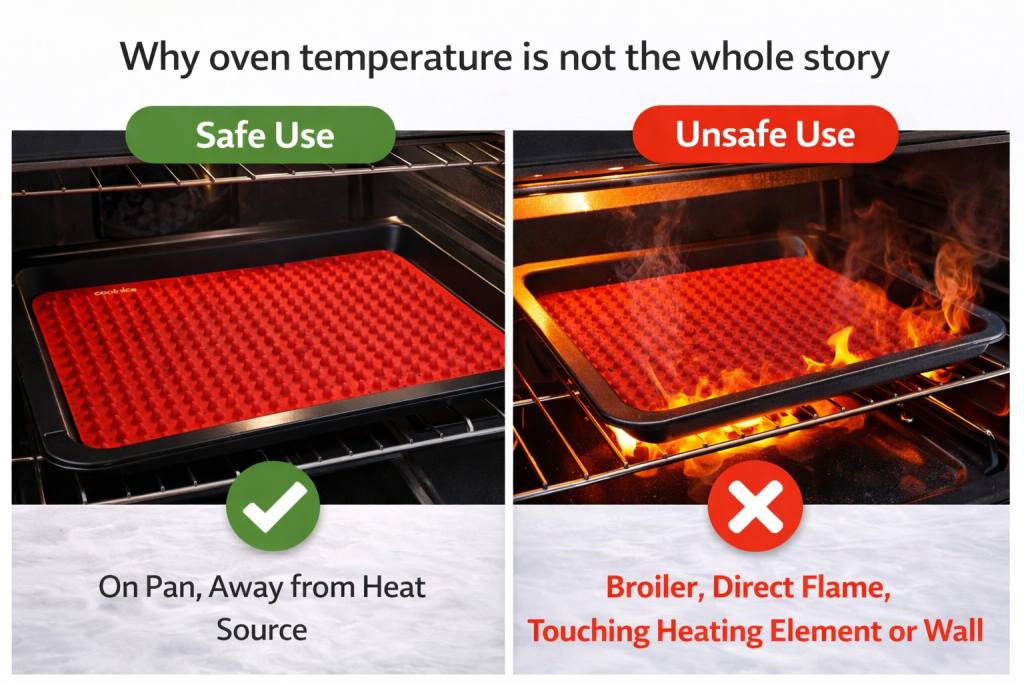
No. Heat resistant does not mean broiler safe, grill safe, stovetop safe, or direct-flame safe.
That distinction matters because many consumer complaints are really misuse complaints. A mat can be completely fine for normal baking and still fail early if someone puts it under a broiler or lets it touch an exposed element.
If your question is really about whether a mat is still safe after aggressive heat exposure, our article on why overheating and breakdown raise silicone mat safety concerns is the better follow-up read.
What overheating can look like
Overheating does not always look dramatic, but there are warning signs that a mat has been stressed beyond the way it was meant to be used:
- persistent sharp odor after heating
- unusual smoke during normal baking
- surface tackiness or brittleness
- edge damage, warping, or separation
- discoloration that appeared after obvious misuse
A mat showing these problems should not be treated like a normal reusable baking surface anymore. It may need to be replaced rather than cleaned and reused.
How temperature affects safety and product life
Temperature limits are not just about one-time safety. They also affect how long the mat stays stable over repeated cycles. Even when a mat does not visibly fail, repeated heat stress near the upper limit can shorten service life.
That is why broad safety claims are less useful than material-and-use evidence. If your team is evaluating kitchenware specs, it helps to understand how a LFGB silicone manufacturer or FDA-oriented supplier controls material stability before the mat reaches the oven.
For the broader household-use question, see how safe silicone baking mats are in everyday baking. Temperature is only one part of the full safety picture.
What buyers should ask suppliers
Buyers should ask for more than a single max temperature number on a quotation sheet. They should ask:
- what test conditions were used to support the rating
- whether the rating applies to the finished product or only the base material
- what misuse conditions are excluded, such as broilers or direct element contact
- how repeat heat cycles affect long-term performance
- what care instructions should be printed for end users
If you are sourcing silicone mats for resale or private label, an experienced OEM silicone mat supplier should be able to explain the temperature range, misuse boundaries, and life-cycle expectations in a way your packaging team can actually use.
A silicone mat temperature guide is really a misuse-prevention guide: know the rated limit, avoid direct heat, and stop assuming every mat behaves the same way.
FAQ
What temperature can silicone baking mats withstand?
Many standard baking mats are rated around 428 F, but the exact limit depends on the specific product. Some specialty mats can go higher.
Are silicone mats heat resistant?
Yes, within their intended use range. Heat resistant does not mean safe for direct flame, broilers, or exposed heating elements.
Can silicone baking mats go above their rated limit once or twice?
That is not a good idea. Even if the mat does not fail immediately, overheating can shorten product life or create odor and surface problems.
Can a silicone mat touch the oven walls?
No. Official use guidance also warns against letting the mat touch the oven walls, because local heat exposure can be much harsher there.
Why do some mats have different temperature ratings?
Because product design differs. Thickness, reinforcement, intended use, and construction all influence the finished product’s safe operating range.
Related Silicone Mat Topics
- Are Silicone Mats Safe?
- Are Silicone Mats Dishwasher Safe?
- Are Silicone Baking Mats Toxic?
- How to Use a Silicone Baking Mat